
Blue Marble Space began with a question:
What symbol could truly represent all of humanity as we venture beyond our world?
An answer to that question became an organization, and the organization became a community, and the community became something I'm proud be part of as we work together to build a better future for everyone.

When I finished my doctorate in 2017, I honestly didn’t know what to do next with my life. I’d already realized that modern academia probably wasn’t for me (for a number of reasons); at least not the tenured professor direction I had always thought I would take. I’d already planned and worked to be able to take some time off altogether, but those few weeks of reading (so many books!) and walking my dogs a bunch flew by.
When I had to find work again, I started off by piecing a few small things together to make ends meet. I was helping a local author, Gregg Eisenberg, to publish his book, Letting Go Is All We Have To Hold Onto: Mind-Altering Jokes! (a fun little book of jokes and aphorisms set up like witty Buddhist koans with a mix of science and philosophy). I was pulling some random gigs here-and-there I’d found on Craigslist, like helping someone move some furniture or other one-off manual labor jobs. And I managed to score a few contracts doing some freelance graphic design, mostly for folks in the science realm.
Thanks to my PhD advisor, I was able to take on an adjunct professor position at the University of Colorado Boulder to teach a class on geochemistry that I had once taken as an undergrad and helped to teach as a grad student. I really loved the process of rebuilding the class materials and teaching, even if I also learned just how little an adjunct professor makes the first time they teach a class (there’s a lot of work to do to get it where you want it before you could teach it again). But these kinds of positions aren’t always secure. I ended up only being contracted for one semester.
But one of the little gigs that really ended up becoming a huge part of my life was taking on some contract work with Blue Marble Space to support their communications efforts.
Along the way, I went from being able to work for 20 or so hours a week on contracts to becoming the Director of Communications and Marketing for the company. Over these last 9 years, it’s been a huge part of my life, my research, and the ways that I’ve been able to engage with so many people around the world. I thought it might be fun here to share just a little bit about Blue Marble Space and what we do, and it all starts with a flag of the Earth.
One Flag in Space
The impetus for Blue Marble Space came first from an idea for having a common identity for all of humanity in space: a single flag representing all of us on Earth together.
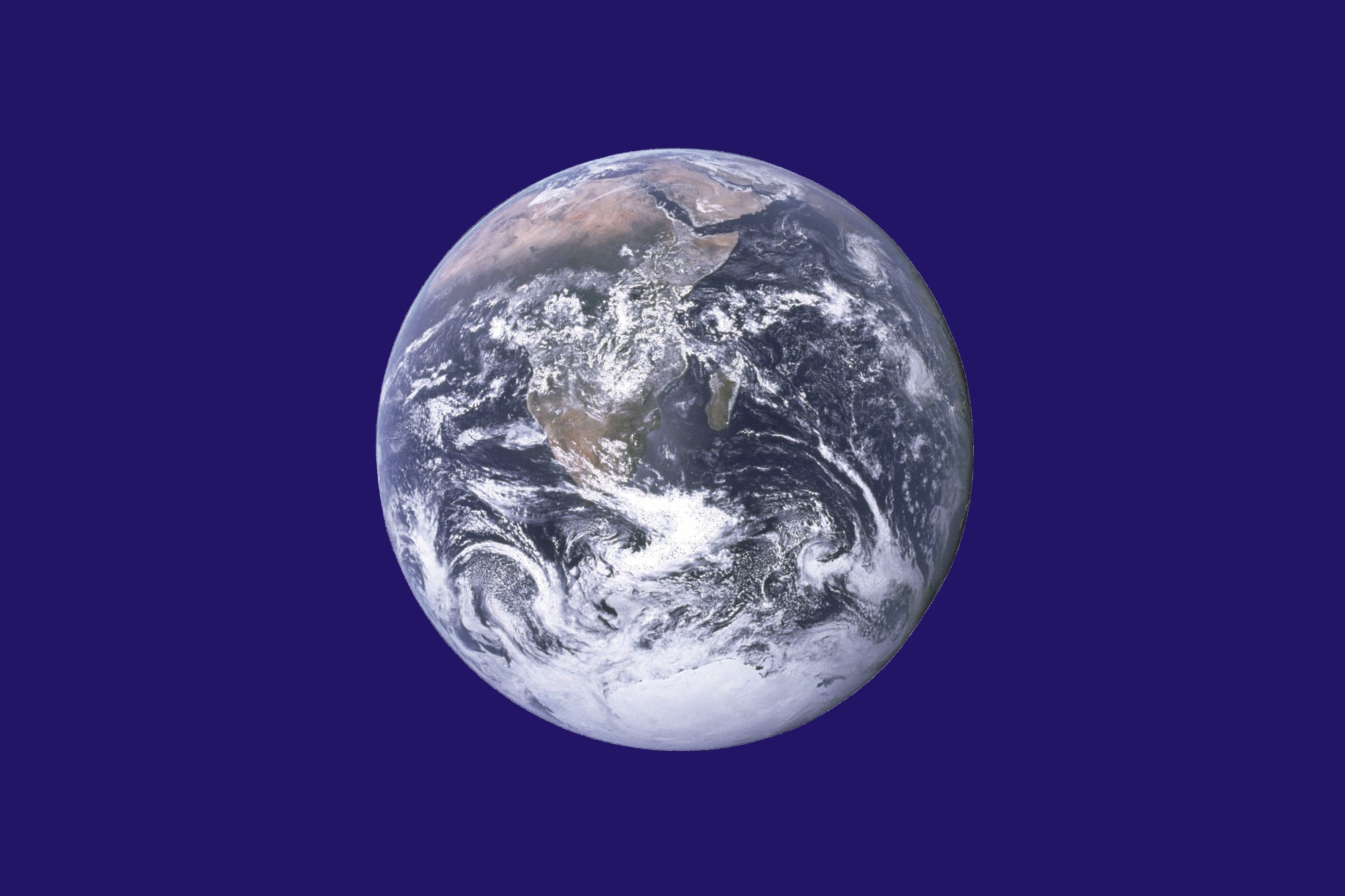
In the Northern Hemisphere summer of 2006, at the Astrobiology Summer School in Santander Spain (which I would later attend in 2012), Sanjoy Som began having the inkling of an idea of having astronauts wear the same flag as a symbol of all of us. The idea took on fuller form at a conference in Hyderabad, India, in 2007; and Sanjoy then in 2008 presented on the idea at the International Astronautical Congress (IAC) in Glasgow, Scotland. Sanjoy’s suggestion was that a flag of the Earth already in use—the Earth Flag, created by John McConnell, who was the Founder and creator of Earth Day—could be used as a common symbol that those traveling into space could wear instead of flags of individual nations.
As Sanjoy himself has shared of that time:
“…During a plenary session at that same conference [IAC 2008], I got the opportunity to show the flag to the entire auditorium and to my great surprise, the entire audience started clapping! The energy behind this moment filled my soul and led me to create Blue Marble Space the following May (2009), with bluemarblespace.org and oneflaginspace.org launching on April 22 of that year.”
An idea for unity sparked the development of the non-profit Blue Marble Space and its first project, One Flag in Space.
Of course, there have been other attempts at designing a flag of the Earth and representing global unity, and they all have their merits and issues (even with the Earth Flag that we use, I’ve always felt like it should have a black background to highlight the Earth in space). But this flag, the basis of One Flag in Space, is what led to the development of Blue Marble Space, and that’s pretty epic. And it’s also cool that the Earth Flag has now flown in space several times, including as recently as this past year.
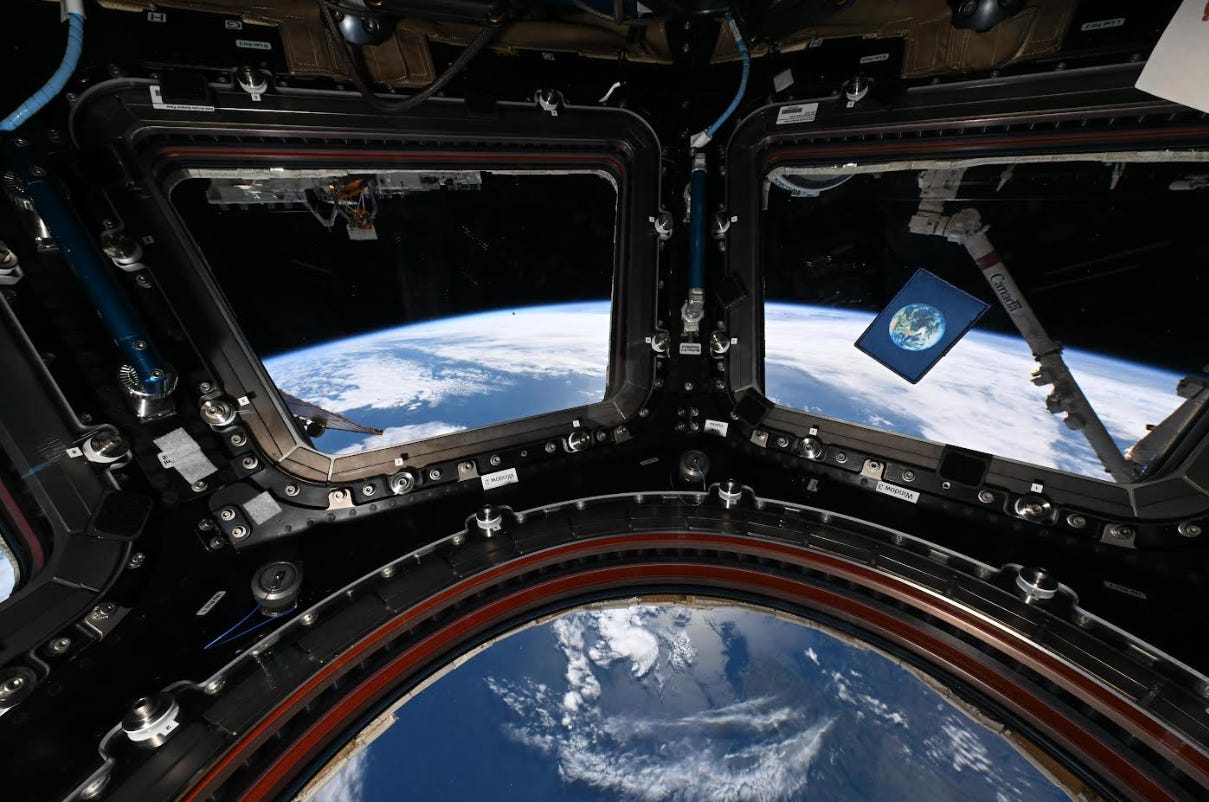
We’re actually running an active campaign right now where people can submit their own photos with the Earth Flag from around the world to have their photos shared through our endeavor. Learn more at One Flag in Space.
Space Exploration Begins at Home
Blue Marble Space itself has evolved as a non-profit organization over time.
The research institution, Blue Marble Space Institute of Science (BMSIS), led by Jacob Haqq-Misra came into existence in 2011. BMSIS itself slowly grew through time to offer affiliations for researchers to join an independent research institution where they could submit their grants for research funding while also building community. BMSIS has always held that affiliates should be skilled in scientific research as well as in enthusiasm and experience in communicating about their science with others. When I first joined Blue Marble Space in 2017, I also became an affiliate scientist at the institution at the same time (and have continued in that role to this day as well).
BMSIS served as the largest and most active initiative of the Blue Marble Space company, but there have been many others.
As stated on the Blue Marble Space website, we use our initiatives to:
Promote the “Blue Marble” as a symbol of international unity in space exploration.
Increase international awareness, education and collaboration in space exploration.
Advance and preserve international awareness of our planet, its resources and its people.
Improve human condition on Earth.
Facilitate the synergy of technology with the environment.
Develop the capability for the human exploration of space.
Understand humanity’s origin and future, and its place in the universe.
In this way, Blue Marble Space has served as an incubator for scientists and scholars within our organization to develop their own non-profit initiatives and ideas.
Some of our past initiatives that we’ve incubated before they grew out on their own or met their needs and were discontinued include:
GreenSpace: A microgreen growing farm and educational initiative
Distant Vantage Media Labs (DVML): A media project for graphics and videos related to space exploration led by Julia DeMarines
The Wrinkled Brain Project: a science education project led by Brendan Mullen
Habitable Press: A publication effort to explore publishing our own books
Astrobiology India: An initiative sculpted and led by our affiliates, students, and researchers to prompt astrobiology in India
Earthlings Hub: A fantastic endeavor led by a couple of our affiliates with the aim of teaching science to students who have been impacted by warfare. They’ve done a remarkable job supporting refugee and orphaned students in war-torn Ukraine.
Astronomy for Equity: A remarkable company working on supporting learning for marginalized and unserved communities globally by creating access to astronomy education and materials, such as solar eclipse viewing glasses and telescopes.
And there have been other projects and ideas that first germinated or took seed at Blue Marble Space.
We also have a number of continuing and active initiatives right now! Among them are those like One Flag in Space and BMSIS, but we also have others that are currently working to fulfill their own missions while being part of the Blue Marble Space family.
Sciworthy, for instance, is a science communication platform built around a deceptively simple idea when it comes to sharing recent research: just tell people what the scientists did, how they did it, and what they found (without any spin or hype or intentional bias). Its writers are scientists writing in their areas of expertise, and every article links directly to the original source of the research. There are no ads, no ideological spin, and no interpretation layered between the reader and the research.
The Explainables and Ad Astra Academy are other active initiatives. The Explainables is a science communication training program built around the idea that researchers need more than technical expertise to make their work matter. Through workshops, bootcamps, and communication design services, the Explainables works with early-career scientists, research institutions, and programs like NASA’s Frontier Development Lab to help scientists sharpen how they present their ideas. Meanwhile, Ad Astra Academy takes the experience of scientific exploration directly to students in some of the world’s most underserved communities. Its customized programs, which have run in Brazil, Bangladesh, and California, invite young people to do real science, and in doing so demonstrate to those students, concretely and viscerally, that they have the capacity to add something new to human knowledge.
Another initiative of Blue Marble Space is the SALAD project. SALAD is the Space Agriculture Laboratory Analysis Database, which has been working to curate and catalog our collective endeavors in space agriculture and astrobotany.
Of all of our initiatives that have had the most impact for me (and have been the most meaningful) at the top of that list are two: the Young Scientist Program and SAGANet.
The Young Scientist Program
Among the most enduring things Blue Marble Space does is invest in the people who will carry this work forward and those who will become global citizen scientists.
The Young Scientist Program (YSP) is the organization’s flagship internship program, and over the years it has become something genuinely rare: an online and globally accessible research experience for undergraduate students and early-career scientists who are curious about Earth and space science, science communication, and the ethical dimensions of doing science in the world.
We’ve now had over 500 people take part in the program from around the world, and seeing them learn and grow has been one of the most stellar parts of my own career. I’ve now been the Director of the program as well as one of the research mentors for many years, and I’m still floored by the quality of applicants we receive who want to work with us on our projects through Blue Marble Space.
Those who are accepted into our program join us as Research Associates, working directly with institute scientists and our colleagues on projects that span astrobiology, planetary science, engineering, and the craft of communicating research to broader audiences. The program doesn’t require travel or relocation. It asks, instead, for time, genuine curiosity, and a willingness to learn how science actually gets done.
What distinguishes the YSP from a conventional internship is the breadth of what it considers essential training. Alongside supervised research, participants engage with modules in science communication and ethics, not as afterthoughts, but as central to what it means to practice science responsibly.
Our Research Associates present their work internally to the BMS community and their friends and families during a long day of science that we call BlueSciCon. I usually end up being online from something like 8:00 in the morning until 10:00 at night managing the talks and recorded videos and such on this day. It’s always tiring, but also so much fun and fills me with so much hope and pride in what our early-career scholars work on and share. The playlist on YouTube for BlueSciCon has 269 videos from previous presentations, and that will just continue to grow!
The program’s philosophy has traveled beyond Blue Marble Space itself. NASA Ames Research Center’s Space Biosciences Division adopted the YSP training model for its own collaborative program, a collaboration focused on developing the next generation of space biology professionals. That the approach found a home at NASA speaks to something the YSP has always understood: that good science and good scientists require the same careful cultivation, and that both are worth the investment. We now manage both the online BMS YSP as well as the in-person NASA YSP, and both programs are stunning reminders of how much impact we can have by supporting and nurturing the growth of the scholars who may follow in our footsteps while learning to also carve their own paths.
This is also part of the nature of SAGANet and the endeavor of Ask an Astrobiologist.
SAGANet, Ask an Astrobiologist, and Stay Curious
SAGANet was founded in 2012 by a group of early career astrobiologists passionate about public engagement in science.
Originally it was S.A.G.A.N., which stood for Social Action for Grassroots Astrobiology Network, and was founded by a group of then-students, including Sara Imari Walker, Sanjoy Som, Betül Kaçar, Heshan “Grasshopper” Illangkoon, Julia DeMarines, and Zach Adam (all of whom have gone on to develop their careers in intriguing and inspiring ways!). Over time, the name transitioned to SAGANet.
SAGANet was first launched as a social media platform dedicated to engagement in astrobiology. There was a book club, links to seminar series and workshops, a podcast, profiles for people to post their own ideas, groups for sharing within specific topics, and more. It was all quite ambitious.
And I’ve written about it before when I wrote a piece last year on what has become the largest endeavor of SAGANet, the show Ask an Astrobiologist!
Stay Curious: The Story of Ask an Astrobiologist

Many of us can’t help but ask “the big questions”. Are we alone? What is life? How did it all begin?
I know some among you here may be fans of the show. If you are aware of it, then you might know that we haven’t had a new episode in some time, and there is a reason for this: the political changes in the U.S. that are defunding science and science communication at the federal level are impacting many of us, and Ask an Astrobiologist is among those endeavors that has been impacted.
Ask an Astrobiologist is no longer going to be a NASA-supported show.
But, have no fear, we have something else in the works. It’s taking some time because it takes a lot of work on top of all of the other things I do, but here’s a brief teaser on what’s coming very soon:
We’re going to rebrand the entire SAGANet endeavor as Ask an Astrobiologist
We’re going to be launching on Twitch as a livestream at the channel AskAstrobio. The livestreams will include some mix of me talking about astrobiology news, maybe sharing some ideas from our book club readings here at The Cosmobiologist, and some conversations within my team and colleagues about questions that come up. We’ll also be answering questions in the Twitch chat! I’m thinking we might call these mini-live episodes “Stay Curious”, in honor of the tagline we’ve used for the ending of the show for many years.
We’re going to start releasing new recorded full-length episodes of the show on the Blue Marble Space YouTube channel. As we are no longer supported by NASA, they also no longer have a say in who we can or cannot have on the show, so the variety of our guests will also be changing. We’re planning at first to release one full-length episode each month, but may be able to increase that cadence if we can garner support for the program through donations.
And, I’ll be doing my best through The Cosmobiologist as well as this new Ask an Astrobiologist endeavor to widen our explorations in the realms of astrobiology and allow those who support our work to be more active (by being tagged/named in shows, being invited to conversations on Twitch, and more!).
There are still some things I need to figure out with the tech for Twitch livestreaming and setting up a recurring schedule, but we are going to have so much more to share about this very soon.
And with these changes at SAGANet, we have some changes coming to Blue Marble Space as well.
To Explore is Human
Blue Marble Space has been so successful in helping to incubate and develop ideas in non-profit science and education and critical human compassion. We’ve worked hard to support early career students with endeavors like the Young Scientist Program and our many initiatives. We’ve been thankful to be able to support conferences and projects of others, like the Astrobiology Science Conference (AbSciCon), the AbSciCon creative writing contest, and the Astrobiology Graduate Conference (AbGradCon). We’ve also now started branching out to have more presence at other meetings in Earth and space science, STEM education, and more.
The research institute, BMSIS, has also grown in leaps and bounds over the years as well. As part of my work for the company, I track all of our community and try to stay in contact with everyone. Here’s a fun breakdown of our researchers right now:
We have 91 current affiliates at BMSIS. Most of us have PhDs or other advanced degrees and are in the Research Scientist track; and among us there are 12 of us in the role of Senior Research Investigator (showing a long term commitment to our research and our community). We also have recently started a track for affiliation in Science Communication & Education (SC&E), providing a pathway for professional-level teachers, educators, communicators, and creators to join an institution (a pathway that is not available at almost all other research institutes globally).
We now have 21 Staff Scientists, most of whom are working in laboratories at NASA Ames Research Center while being managed with support from Blue Marble Space.
We also now have 93 Visiting Scholars, who take on yearly positions with us to work on a number of our projects at Blue Marble Space.
On top of this, we have 14 current YSP interns at NASA Ames and will likely be bringing on several dozen more to the online program starting this June.
Our community has grown. Our reach has widened. And we’ve continually shown that we can do more together while honoring both what we share as well as our differences. We can build a better and more sustainable future on Earth and beyond.
But Blue Marble Space, as a non-profit organization with a large research branch, is not immune to changes in governance and politics. The U.S. is seeing the greatest cuts to science and humanitarian funding at the federal level that we have ever seen before. This could change in coming years, but it is a strong reminder to many of us in the non-profit realm that we need to become more self-sufficient outside of government based grant funding.
To this end, we will soon be announcing a new rebranding at Blue Marble Space. We’re going to be consolidating some things, making the brand of Blue Marble Space more central to all we do, and doing our best to get louder on the global stage in voicing our need for support. We’ll be expanding in our editorial services and output, expanding our presence on social media and at in-person meetings and events, and we fully intend to become even more community-focused by increasing access to our services and skills while raising others up along with us.
While this endeavor here at The Cosmobiologist is my own work, if you want to be a greater part of Blue Marble Space and join us on the ride forward, then I can highly recommend checking out our Supporters Circle. It’s a monthly donation campaign that allows people to support the work of Blue Marble Space while also receiving special rewards along the way (and those in the circle will also hear from me directly a lot more!).
Sometime soon, I’ll share more about our new directions with Blue Marble Space. I’m so thankful to be a part of this community and to be able to share even more of my thoughts and research beyond The Cosmobiologist within such a global network of scholars, thinkers, dreamers, and doers.
The future can be bright when we light the way together!
Thanks so much for reading along. As always, it is such a pleasure to hear from you if you have ideas you want to share, topics you think I might want to explore, or just want to connect. I write about a lot of things here, and there’s still so much more to come. We’ve got more Astrobiology 101, more Mythologies of Alien Life, more Friday Meanderings, and lots, lots more on the science and philosophy of alien life.
Until next time, stay curious!
Incredibly inspiring work Graham! 🙏 🙏
Thank you so much for writing this up and sharing your own story a little bit! Looking forward to the exciting new changes!